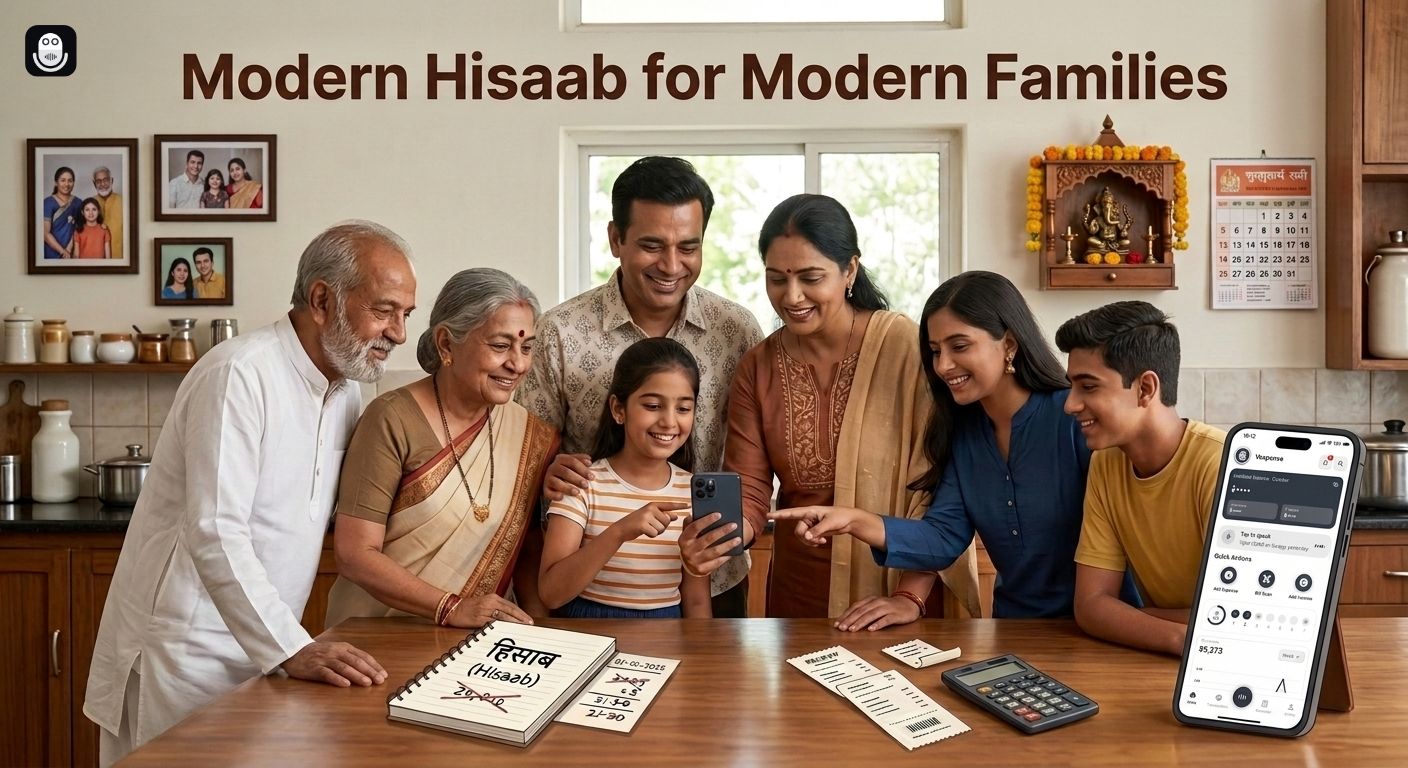
The Household “Hisaab” Problem in Indian Families
In Indian households, money flows in multiple directions.
Mummy buys groceries (₹1,200). Papa pays school fees (₹3,500). Sister buys medicines (₹450). Brother refills water (₹200). Everyone spends, but one person – usually a parent – manages the “Hisaab” (household accounts).
The problem? Nobody writes things down.
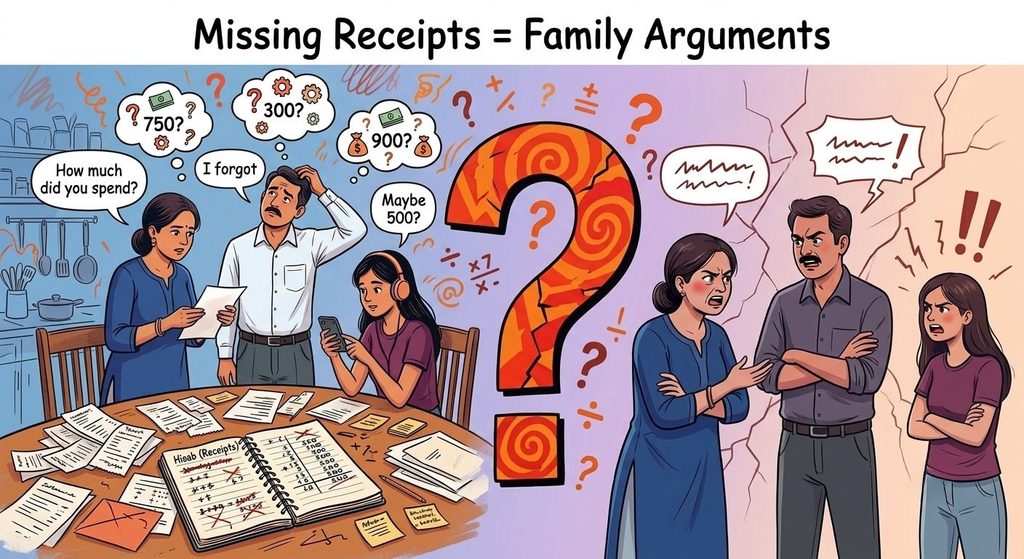
Mummy remembers spending ₹1,200 on groceries but forgets the exact items. Papa doesn’t save receipts. Sister loses track after three shopping trips. By month-end, nobody knows: “How much did groceries actually cost? How much did utilities increase?”
Without proper “Hisaab,” families argue about money.
“Why is the grocery bill so high?” “Because you also bought that expensive medicine!” “No, that was prasad for the temple!” Tension builds. Nobody trusts the numbers.
This is the household finance crisis: Complete spending exists, but nobody captures it properly.
Why Traditional Household “Hisaab” Fails
The Manual Record Problem
Keeping a household “Hisaab” manually requires:
- Writing every receipt (tedious, forgotten)
- Organizing by category (complex with multiple people)
- Reconciling at month-end (error-prone, argumentative)
- Sharing passwords (unsafe, privacy-invading)
Result: 67% of Indian households keep No household “Hisaab” at all. They just guess.
The Missing Receipts Issue
When multiple family members spend money:
- Some remember the amount (but not exact)
- Some have receipts (but forget to report)
- Some forget purchases happened entirely
- Some round up “to be safe”
By month-end: Real spending might be ₹15,000, but “Hisaab” shows ₹16,500 (or ₹14,200). Nobody trusts the numbers.
The Tension
Without clear spending records, families assume the worst:
- “Maybe you’re hiding purchases?”
- “The groceries are definitely more expensive than before”
- “Did we actually spend that much on utilities?”
Trust erodes. Arguments begin. Money – which should unite families – divides them.
The Modern Solution: Digital Shared “Hisaab”
Modern households need a way to:
- Log shared expenses instantly (no waiting)
- Let anyone contribute data (multi-user)
- Keep everything transparent (everyone sees)
- Require NO password sharing (privacy-safe)
- Organize automatically (no manual work)
Digital “Hisaab” solves all of this.
How It Works
Step 1: Voice Logging Mummy: “Spent 1200 on groceries” App logs instantly. Category assigned: Groceries.
Papa: “Spent 3500 on school fees” App logs. Category: Education.
Sister: “Spent 450 on medicines” App logs. Category: Health.
Step 2: Receipt Scanning (Optional) Any family member can photograph a receipt. App automatically extracts:
- Amount (₹850)
- Vendor (Big Basket)
- Date (timestamp)
- Category (auto-detected: Groceries)
No manual data entry. Just photograph, upload, done.
Step 3: Real-Time Transparency Everyone sees the shared “Hisaab”:
- Groceries: ₹4,200 (month-to-date)
- Utilities: ₹1,800
- School Fees: ₹3,500
- Medicines: ₹450
- Transportation: ₹600 Total: ₹10,550
No surprises at month-end. Everyone knows exactly where money goes.
Step 4: Monthly Settlement Perfect “Hisaab” → Clear understanding → No arguments.
Why Multi-User “Hisaab” Prevents Arguments
Clear Visibility = Trust
When everyone can see:
- Exact amount spent
- What it was spent on
- Who made the expense
- When it was made
There’s no room for miscommunication. Facts replace assumptions.
Shared Responsibility
When anyone can log expenses:
- Nobody forgets to report
- Nobody hides purchases
- Everyone contributes to accuracy
- Ownership becomes shared
Transparent Discussions
Month-end conversation changes from:
- “Why is everything so expensive?” (accusatory)
- “Vegetables are 20% more expensive this month—let’s adjust” (factual)
Tension reduces. Problem-solving increases.
The Privacy Advantage: No Passwords
Traditional apps need bank passwords. This creates problems:
- Privacy invasion (everyone sees your salary)
- Security risk (shared passwords = hackable)
- Trust issues (monitoring concerns)
Digital “Hisaab” is different:
Anyone simply logs what they spent without sharing:
- Bank login
- Account numbers
- Salary information
- Past transactions
So, it ensures complete privacy, complete transparency & maximum security.
The Bottom Line
Traditional household “Hisaab” requires:
- Manual record-keeping (tedious)
- Password sharing (risky)
- Trust assumptions (unreliable)
- Month-end arguments (frustrating)
Digital “Hisaab” requires:
- Voice logging (3 seconds)
- No password sharing (safe)
- Real-time visibility (transparent)
- Fact-based discussions (peaceful)
For Indian households where multiple people spend shared money, digital “Hisaab” transforms finance from a source of tension into a tool for family unity.
Ready for Transparent Family Finance?
Download Voxpense Free →
Log household expenses via voice. Keep perfect “Hisaab” as a family. Stop arguments about money. Build financial trust.
Start today. See how digital “Hisaab” brings peace to your household within one month.
Leave a Reply