
The Post-Vacation Financial Shock
You return from holiday feeling relaxed and refreshed.
Then you check your credit card statement.
You spent ₹95,000. Your budget was ₹60,000.
You vaguely remember expensive dinners. That unplanned shopping trip. The last-minute tour. But the exact damage? Unknown.
This is post-vacation guilt. And it affects 73% of travelers who don’t actively track spending while traveling.
The problem is simple: You stopped tracking expenses the moment you left for vacation.
Spreadsheets are impossible on the beach. Typing in a cafe is tedious. Opening apps while sightseeing kills the travel experience. So you decided: “I’ll track it when I return.”
By return, you’ve forgotten half the expenses. The damage is worse than you imagined.
Why Travelers Abandon Expense Tracking
The Friction of Traditional Tracking
Traditional vacation budget apps require:
- Typing (slow on mobile)
- App switching (interrupts travel)
- Categorizing (requires decisions while on holiday)
- Reviewing daily (homework during vacation)
Real impact: 71% of travelers stop tracking by day 3 of their trip.
The Lost Data Problem
Without real-time logging:
- First, you forget expenses within hours.
- As a result, memory becomes unreliable—was that ₹800 or ₹1,200?
- Consequently, you may significantly underestimate your spending.
- Eventually, a “surprise” credit card bill arrives.
The Budget Spiral
Without tracking, spending can gradually increase:
- Initially, Days 1–2: You stick to your budget.
- Then, Days 3–5: “I’m on vacation, I’ll be mindful.”
- After that, Days 6–10: You stop tracking, and spending increases by 40–60%.
- Eventually, Day 11+: The budget is abandoned, and you spend freely.
The Travel Expense Tracking Solution: Voxpense
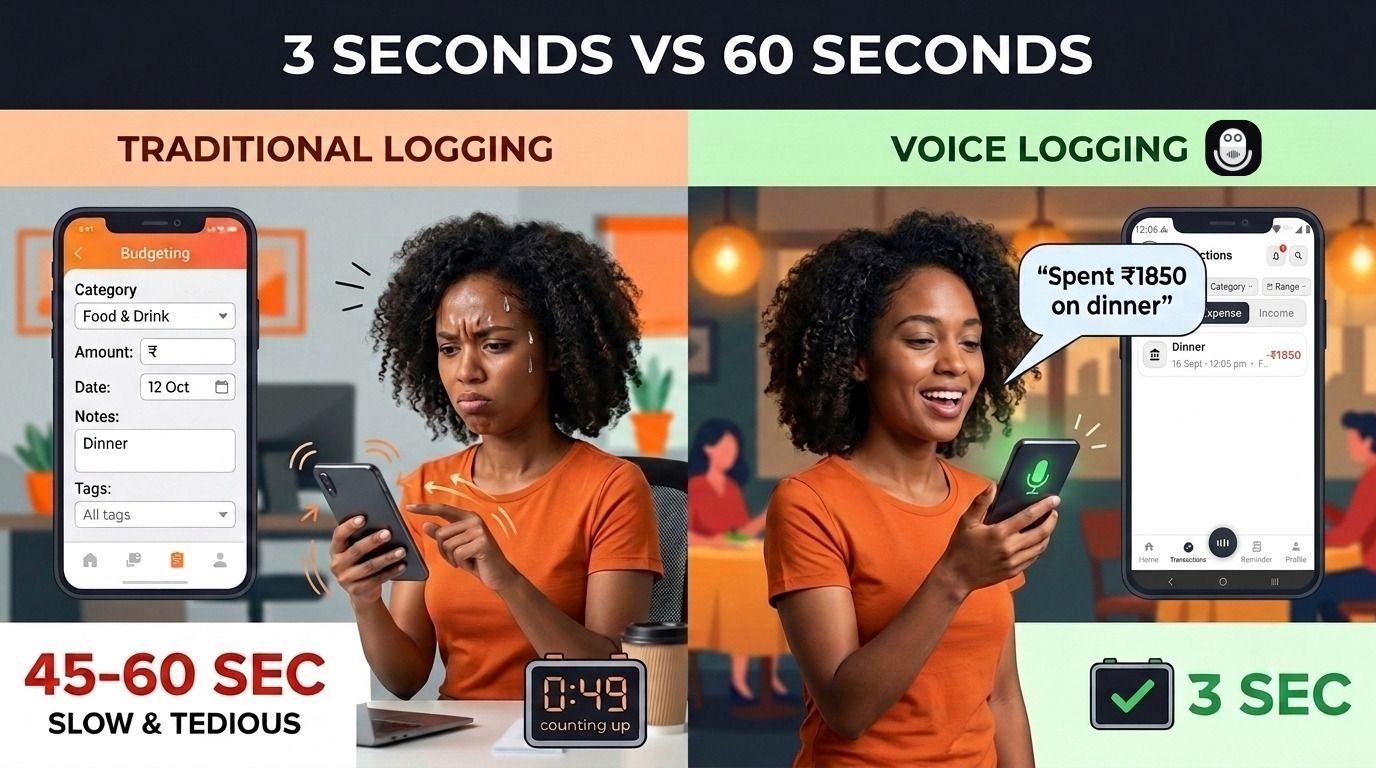
The best travel expense tracker removes tracking friction entirely.
Imagine:
You’re at a restaurant in Goa. The bill arrives: ₹1,850. You speak into your phone: “Spent 1850 on dinner.”
Time: 3 seconds. Skip the hassle of opening apps, typing, or categorizing.
Later, you take a taxi. ₹350 fare. You say: “Spent 350 on taxi.”
3 seconds again. Done.
You’re back to sightseeing instantly.
Meanwhile, your travel expense tracker is updating in real-time:
- Expense logged
- Amount recorded
- Category assigned (AI understands “restaurant” and “taxi”)
- Budget updated
Zero friction. Complete tracking. Vacation never interrupted!
Why Voice Beats Traditional Travel Expense Tracking
Speed Advantage
- Traditional tracker: 45-60 seconds per expense (type, categorize, navigate)
- Voice tracker: 3-5 seconds per expense (speak naturally)
Experience Quality
You don’t want to “work” on vacation. Voice tracking feels natural—like talking to a friend.
Traditional typing feels like homework.
Real-Time Accuracy
Logging immediately = accurate amounts. Logging later = estimated guesses.
Studies show: Real-time logging is 95% accurate. Delayed logging is 60-70% accurate.
Automatic Categorization
AI understands context:
- “Spent 500 on Uber” = Transportation
- “Spent 2000 on Taj Mahal ticket” = Activities
- “Spent 1200 on hotel” = Accommodation
- “Spent 800 on snacks” = Food
No decisions required while on vacation.
The Holiday Money Manager Framework
A holiday money manager tracks three categories:
Pre-Trip Planning
Set your total budget (example: ₹60,000 for 10 days). Allocate by category: Accommodation (₹20,000), Food (₹15,000), Activities (₹10,000), Transport (₹8,000), Shopping (₹7,000)
During-Trip Tracking
Speak expenses as they happen. Watch your budget updates in real time.
Dashboard shows:
- Total spent so far: ₹24,500
- Remaining budget: ₹35,500
- Days left: 5 days
- Daily burn rate: ₹4,900/day
- On track? YES (spending below budget)
Post-Trip Analysis
See exactly what you spent where:
- Accommodation: ₹18,500 (92% of budget)
- Food: ₹14,200 (95% of budget)
- Activities: ₹9,800 (98% of budget)
- Transport: ₹7,500 (94% of budget)
- Shopping: ₹6,200 (89% of budget)
Total spent: ₹56,200 (94% of budget)
Result: No post-vacation guilt. No surprise credit card bill. Complete control.
Why This Matters: The Expense Tracker Psychology
The Hawthorne Effect: When people know they’re being observed (or tracking), behavior changes.
Just logging expenses makes you spend 15-20% less.
Why? Because tracking creates awareness. Awareness creates mindfulness. Mindfulness creates better decisions.
You don’t need willpower. You need visibility.
How to Track Vacation Expenses (3 Steps)
1: Download a Voxpense expense tracker before you leave
2: Set your budget and category allocations
3: Speak every expense while traveling (3 seconds each)
Done. The dashboard handles everything else.
The Bottom Line
73% of travelers don’t track vacation spending. The result? Post-vacation guilt, budget overruns, and financial stress that diminishes the joy of travel.
The best travel expense tracker removes this stress entirely.
Voice commands take 3 seconds per expense. Automatic categorization removes decisions. Real-time dashboard prevents surprises.
You get complete financial control without interrupting your vacation.
Ready for Guilt-Free Vacations?
Download Voxpense Free →
Track vacation expenses by voice. Stay on budget. Return home without financial shock.
Start free. No credit card required.
Leave a Reply