Tag: adhd budget app

  • ADHD Tax: Stop Late Fees with Bill Reminders

    ADHD Tax: Stop Late Fees with Bill Reminders

    You Didn’t Forget Because You Don’t Care

    You knew the electricity bill was due on the 10th and meant to pay it on the way home. Then a meeting ran late, a message needed a reply, and by the time you remembered, the portal was closed.

    The next month, a ₹450 late fee appeared on your statement.

    If this sounds familiar, you may be paying what many people with ADHD call the ADHD tax: the steady, avoidable cost of late fees, overdraft charges, and penalties that come from forgetting things that matter.

    The tax is not a sign of carelessness. It is a predictable result of working with a brain that struggles with time awareness, task switching, and remembering things that are out of sight.

    What Is the ADHD Tax?

    The ADHD tax describes the extra money and stress that attention-related challenges can cost over time. It usually shows up in small, repeated ways:

    • Late fees on credit cards, utilities, phone plans, and subscriptions
    • Overdraft charges when an auto-debit hits before you have topped up your account
    • Reconnection fees after a service is suspended for non-payment
    • Lost discounts from early-payment rewards that expired unnoticed
    • Emergency purchases made to replace something that lapsed, like insurance or a prepaid plan

    Each charge looks small on its own. A ₹300 fee here, a ₹600 overdraft there. Over a year, though, these penalties can quietly add up to thousands of rupees, money that could have gone toward savings, rent, or a goal you care about.

    The real cost is often bigger than the fees. Each missed bill creates shame, and shame makes the next bill harder to face. Many people avoid opening their banking app at all, which makes the problem worse.

    Why Standard Advice Often Fails

    Most money advice says the same things: “Set a reminder,” “Make a spreadsheet,” or “Just be more disciplined.”

    For many people with ADHD, these tips break down quickly:

    • Phone reminders get dismissed. A single notification at 9 AM is easy to swipe away and forget by noon.
    • Spreadsheets need maintenance. A system that depends on remembering to update it will eventually stop being updated.
    • Willpower runs out. Telling yourself to “try harder” does not create a memory system.

    What helps is a system that works for you: one that brings bills to you at the right moments, in a way you cannot easily ignore, without relying on memory.

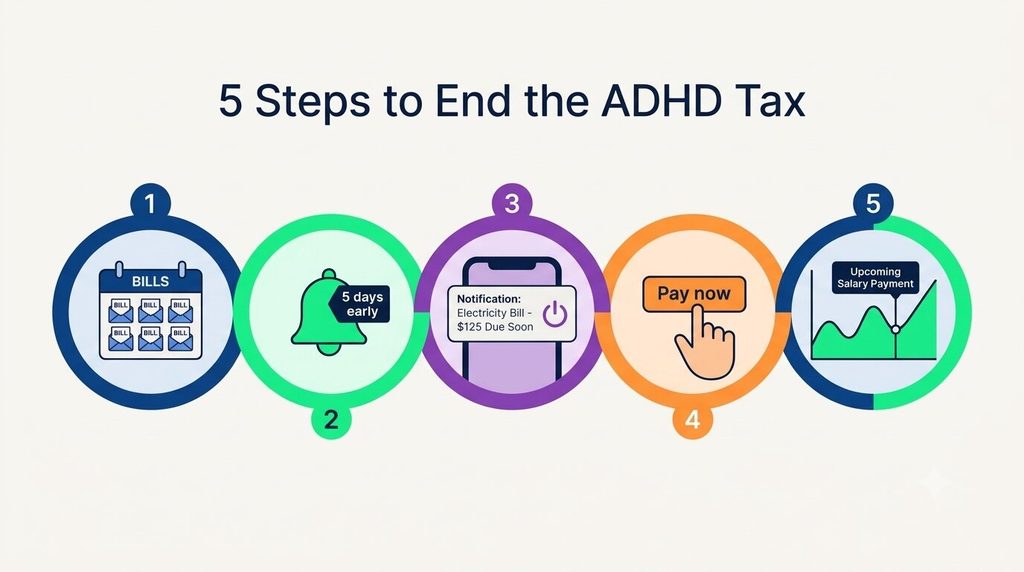
    Five Ways to Stop Paying the ADHD Tax
    Five Ways to Stop Paying the ADHD Tax

    1. Put Every Bill in One Calendar

    Scattered due dates are hard to track. Start by listing every recurring payment: credit cards, EMIs, electricity, water, gas, mobile recharge, insurance premiums, streaming subscriptions, and rent.

    Once they are in one place, you can see the full picture. Many people discover subscriptions they forgot they had, which is a bonus.

    2. Use Reminders Before the Due Date, Not on It

    A reminder that arrives on the due date gives you no room to act. Set alerts several days ahead, such as 5 days, 2 days, and the morning of. Early nudges turn an urgent task into a manageable one.

    3. Choose Push Notifications That Demand Attention

    Not all alerts are equal. A proactive push notification that tells you exactly what is due, how much, and when is far more useful than a vague “You have bills” message. Specific information removes the mental work of figuring out what to do next.

    4. Pay Immediately When You Can

    Whenever you see a reminder and have the funds, pay on the spot. Waiting “until later” is the most common way a manageable bill becomes a late fee. Keep your payment method handy so that paying takes one tap.

    5. Plan for Cash Flow, Not Just Due Dates

    Some bills fail not because you forgot, but because the money was not there. Check upcoming bills against your income dates. If rent is due on the 1st and your salary arrives on the 3rd, a bill calendar will show the gap before it becomes an overdraft.

    How Voxpense Acts as a Safeguard

    Voxpense is built to reduce the mental load that causes the ADHD tax. Its bill calendar and proactive notifications work together so that you do not have to remember everything yourself.

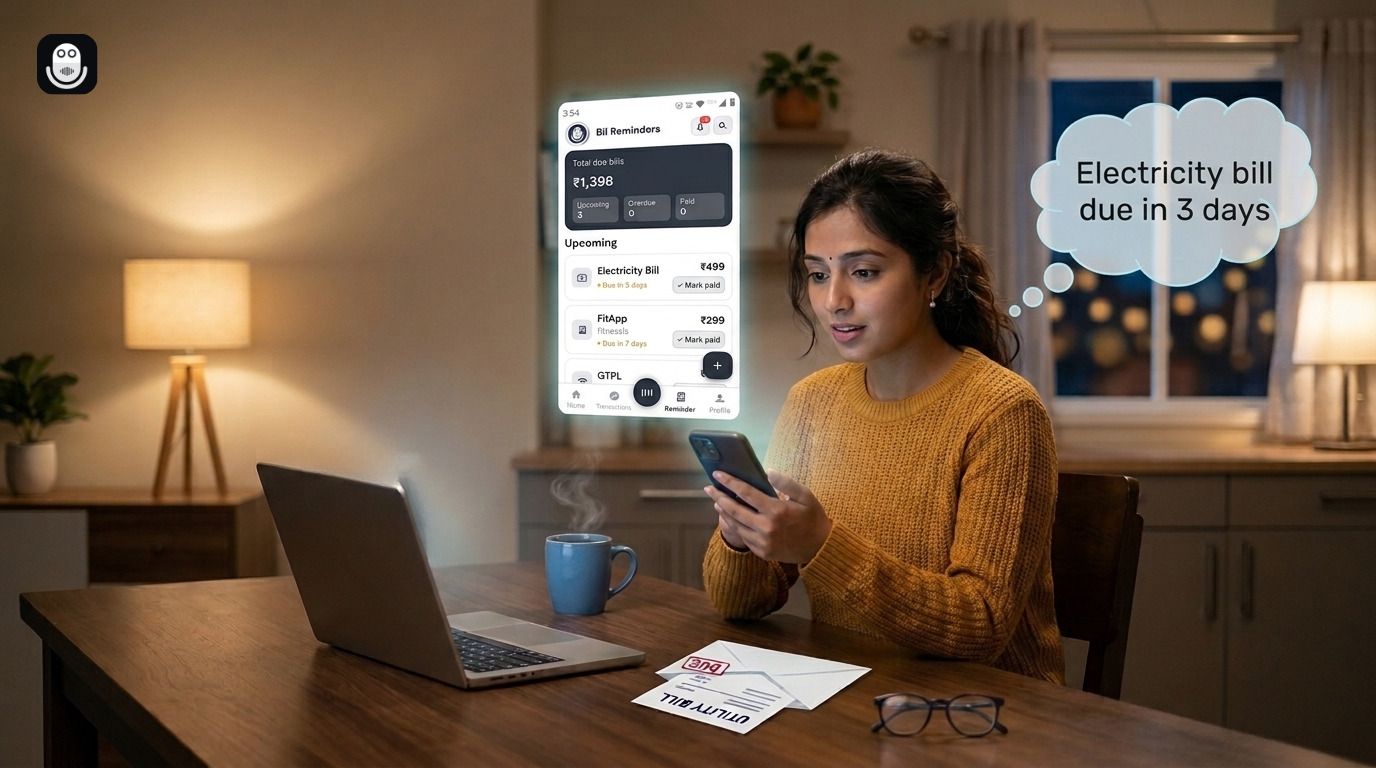
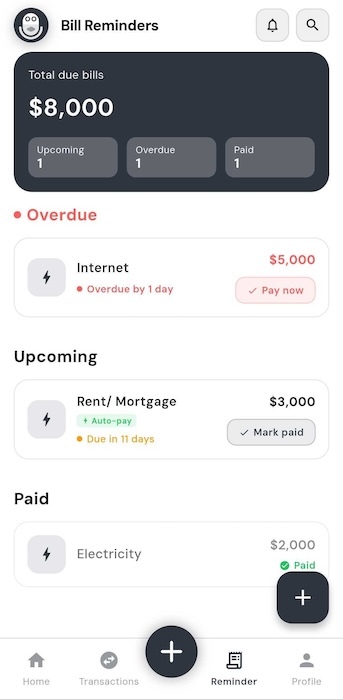
    Automated bill calendar: Recurring bills appear in one view, sorted by due date, so you always know what is coming up this week and this month.

    Proactive push notifications: You receive timely alerts before each deadline, with the bill name and amount included. The reminder tells you what to do, not just that something is due.

    Voice-based updates: If you pay a bill in cash or through another app, you can log it by speaking. For example, say “Paid 2,000 electricity” and the record updates immediately, so your calendar stays accurate without extra typing.

    Clear status tracking: Paid and unpaid bills are visible at a glance, which reduces the anxiety of wondering whether something was handled.

    Think of Voxpense as a strict but supportive guardrail. It does not judge you for forgetting. It simply makes sure the reminder reaches you before the penalty does.

    A Simple Setup You Can Finish Today
    1. Spend 15 minutes listing your recurring bills with amounts and due dates.
    2. Add them to Voxpense so they appear in your bill calendar.
    3. Turn on push notifications with reminders set 5 days and 2 days before each due date.
    4. Review your calendar every Sunday for five minutes to plan the week.
    5. Log payments immediately by voice or tap, so your records stay current.

    After one month, most people find that the bills they used to dread have become routine.

    Stop Paying for Forgetting

    The ADHD tax is real, but it is not permanent. A good system can remove most of it.

    Put your bills in one place. Get reminders before they are due. Pay the moment you can. Let your calendar carry the memory so you do not have to.

    Every late fee you avoid is money you keep.

    Ready to End Avoidable Late Fees?

    Download Voxpense Free →

    Set up your bill calendar in minutes, turn on proactive reminders, and stop losing money to forgetfulness.


  • Household Expense Tracker for Shared Expenses

    Household Expense Tracker for Shared Expenses

    The Household “Hisaab” Problem in Indian Families

    In Indian households, money flows in multiple directions.

    Mummy buys groceries (₹1,200). Papa pays school fees (₹3,500). Sister buys medicines (₹450). Brother refills water (₹200). Everyone spends, but one person – usually a parent – manages the “Hisaab” (household accounts).

    The problem? Nobody writes things down.

    Mummy remembers spending ₹1,200 on groceries but forgets the exact items. Papa doesn’t save receipts. Sister loses track after three shopping trips. By month-end, nobody knows: “How much did groceries actually cost? How much did utilities increase?”

    Without proper “Hisaab,” families argue about money.

    “Why is the grocery bill so high?” “Because you also bought that expensive medicine!” “No, that was prasad for the temple!” Tension builds. Nobody trusts the numbers.

    This is the household finance crisis: Complete spending exists, but nobody captures it properly.

    Why Traditional Household “Hisaab” Fails

    missing receipts

    The Manual Record Problem

    Keeping a household “Hisaab” manually requires:

    • Writing every receipt (tedious, forgotten)
    • Organizing by category (complex with multiple people)
    • Reconciling at month-end (error-prone, argumentative)
    • Sharing passwords (unsafe, privacy-invading)

    Result: 67% of Indian households keep No household “Hisaab” at all. They just guess.

    The Missing Receipts Issue

    When multiple family members spend money:

    • Some remember the amount (but not exact)
    • Some have receipts (but forget to report)
    • Some forget purchases happened entirely
    • Some round up “to be safe”

    By month-end: Real spending might be ₹15,000, but “Hisaab” shows ₹16,500 (or ₹14,200). Nobody trusts the numbers.

    The Tension

    Without clear spending records, families assume the worst:

    • “Maybe you’re hiding purchases?”
    • “The groceries are definitely more expensive than before”
    • “Did we actually spend that much on utilities?”

    Trust erodes. Arguments begin. Money – which should unite families – divides them.

    The Modern Solution: Digital Shared “Hisaab”

    Modern households need a way to:

    • Log shared expenses instantly (no waiting)
    • Let anyone contribute data (multi-user)
    • Keep everything transparent (everyone sees)
    • Require NO password sharing (privacy-safe)
    • Organize automatically (no manual work)

    Digital “Hisaab” solves all of this.

    How It Works

    Step 1: Voice Logging Mummy: “Spent 1200 on groceries” App logs instantly. Category assigned: Groceries.

    Papa: “Spent 3500 on school fees” App logs. Category: Education.

    Sister: “Spent 450 on medicines” App logs. Category: Health.

    Step 2: Receipt Scanning (Optional) Any family member can photograph a receipt. App automatically extracts:

    • Amount (₹850)
    • Vendor (Big Basket)
    • Date (timestamp)
    • Category (auto-detected: Groceries)

    No manual data entry. Just photograph, upload, done.

    Step 3: Real-Time Transparency Everyone sees the shared “Hisaab”:

    • Groceries: ₹4,200 (month-to-date)
    • Utilities: ₹1,800
    • School Fees: ₹3,500
    • Medicines: ₹450
    • Transportation: ₹600 Total: ₹10,550

    No surprises at month-end. Everyone knows exactly where money goes.

    Step 4: Monthly Settlement Perfect “Hisaab” → Clear understanding → No arguments.

    Why Multi-User “Hisaab” Prevents Arguments

    Clear Visibility = Trust

    When everyone can see:

    • Exact amount spent
    • What it was spent on
    • Who made the expense
    • When it was made

    There’s no room for miscommunication. Facts replace assumptions.

    Shared Responsibility

    When anyone can log expenses:

    • Nobody forgets to report
    • Nobody hides purchases
    • Everyone contributes to accuracy
    • Ownership becomes shared

    Transparent Discussions

    Month-end conversation changes from:

    • “Why is everything so expensive?” (accusatory)
    • “Vegetables are 20% more expensive this month—let’s adjust” (factual)

    Tension reduces. Problem-solving increases.

    The Privacy Advantage: No Passwords

    Traditional apps need bank passwords. This creates problems:

    • Privacy invasion (everyone sees your salary)
    • Security risk (shared passwords = hackable)
    • Trust issues (monitoring concerns)

    Digital “Hisaab” is different:

    Anyone simply logs what they spent without sharing:

    • Bank login
    • Account numbers
    • Salary information
    • Past transactions

    So, it ensures complete privacy, complete transparency & maximum security.

    The Bottom Line

    Traditional household “Hisaab” requires:

    • Manual record-keeping (tedious)
    • Password sharing (risky)
    • Trust assumptions (unreliable)
    • Month-end arguments (frustrating)

    Digital “Hisaab” requires:

    • Voice logging (3 seconds)
    • No password sharing (safe)
    • Real-time visibility (transparent)
    • Fact-based discussions (peaceful)

    For Indian households where multiple people spend shared money, digital “Hisaab” transforms finance from a source of tension into a tool for family unity.

    Ready for Transparent Family Finance?

    Download Voxpense Free →

    Log household expenses via voice. Keep perfect “Hisaab” as a family. Stop arguments about money. Build financial trust.

    Start today. See how digital “Hisaab” brings peace to your household within one month.

  • Best Travel Expense Tracker for Vacation Budgeting

    Best Travel Expense Tracker for Vacation Budgeting

    The Post-Vacation Financial Shock

    You return from holiday feeling relaxed and refreshed.

    Then you check your credit card statement.

    You spent ₹95,000. Your budget was ₹60,000.

    You vaguely remember expensive dinners. That unplanned shopping trip. The last-minute tour. But the exact damage? Unknown.

    This is post-vacation guilt. And it affects 73% of travelers who don’t actively track spending while traveling.

    The problem is simple: You stopped tracking expenses the moment you left for vacation.

    Spreadsheets are impossible on the beach. Typing in a cafe is tedious. Opening apps while sightseeing kills the travel experience. So you decided: “I’ll track it when I return.”

    By return, you’ve forgotten half the expenses. The damage is worse than you imagined.

    Why Travelers Abandon Expense Tracking

    The Friction of Traditional Tracking

    Traditional vacation budget apps require:

    • Typing (slow on mobile)
    • App switching (interrupts travel)
    • Categorizing (requires decisions while on holiday)
    • Reviewing daily (homework during vacation)

    Real impact: 71% of travelers stop tracking by day 3 of their trip.

    The Lost Data Problem

    Without real-time logging:

    • First, you forget expenses within hours.
    • As a result, memory becomes unreliable—was that ₹800 or ₹1,200?
    • Consequently, you may significantly underestimate your spending.
    • Eventually, a “surprise” credit card bill arrives.

    The Budget Spiral

    Without tracking, spending can gradually increase:

    • Initially, Days 1–2: You stick to your budget.
    • Then, Days 3–5: “I’m on vacation, I’ll be mindful.”
    • After that, Days 6–10: You stop tracking, and spending increases by 40–60%.
    • Eventually, Day 11+: The budget is abandoned, and you spend freely.

    The Travel Expense Tracking Solution: Voxpense

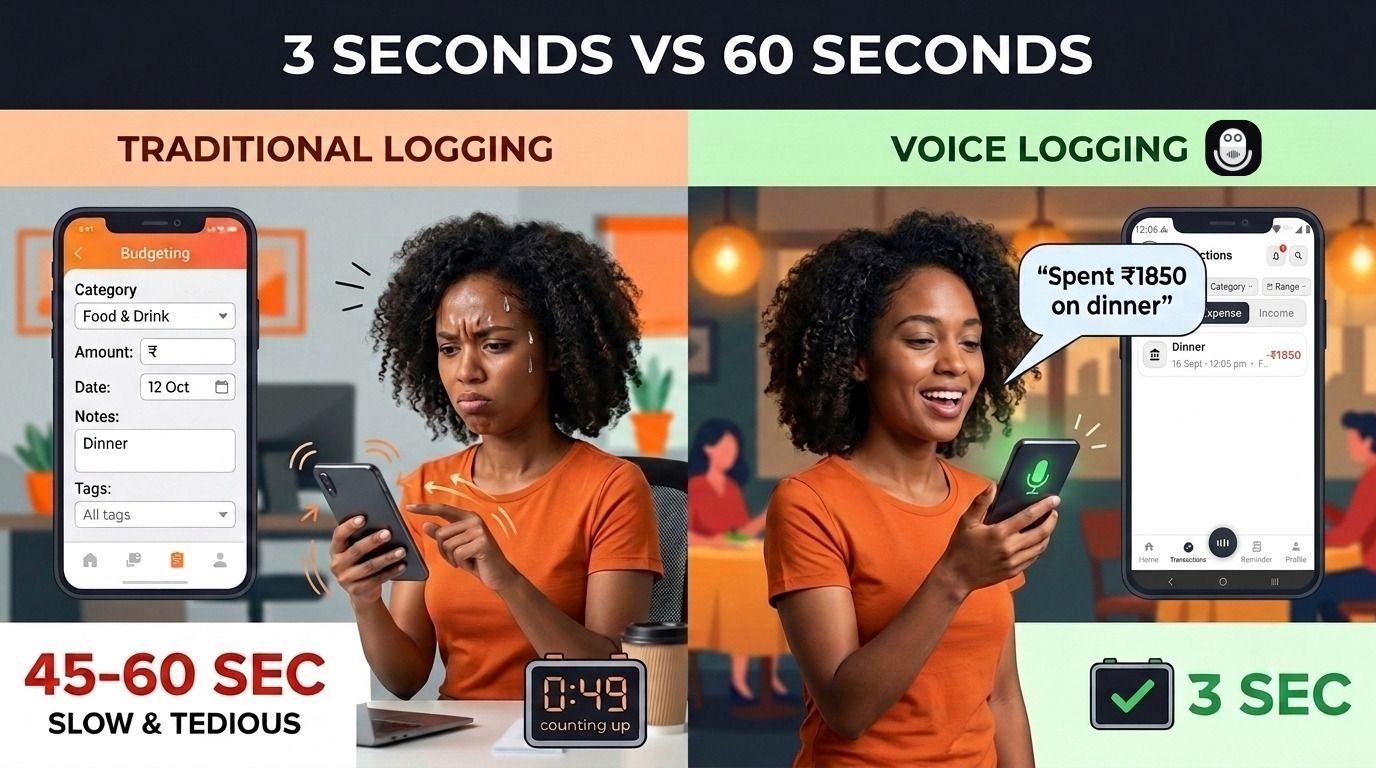
    traditional vs voice logging

    The best travel expense tracker removes tracking friction entirely.

    Imagine:

    You’re at a restaurant in Goa. The bill arrives: ₹1,850. You speak into your phone: “Spent 1850 on dinner.”

    Time: 3 seconds. Skip the hassle of opening apps, typing, or categorizing.

    Later, you take a taxi. ₹350 fare. You say: “Spent 350 on taxi.”

    3 seconds again. Done.

    You’re back to sightseeing instantly.

    Meanwhile, your travel expense tracker is updating in real-time:

    • Expense logged
    • Amount recorded
    • Category assigned (AI understands “restaurant” and “taxi”)
    • Budget updated

    Zero friction. Complete tracking. Vacation never interrupted!

    Why Voice Beats Traditional Travel Expense Tracking

    Speed Advantage

    • Traditional tracker: 45-60 seconds per expense (type, categorize, navigate)
    • Voice tracker: 3-5 seconds per expense (speak naturally)

    Experience Quality

    You don’t want to “work” on vacation. Voice tracking feels natural—like talking to a friend.

    Traditional typing feels like homework.

    Real-Time Accuracy

    Logging immediately = accurate amounts. Logging later = estimated guesses.

    Studies show: Real-time logging is 95% accurate. Delayed logging is 60-70% accurate.

    Automatic Categorization

    AI understands context:

    • “Spent 500 on Uber” = Transportation
    • “Spent 2000 on Taj Mahal ticket” = Activities
    • “Spent 1200 on hotel” = Accommodation
    • “Spent 800 on snacks” = Food

    No decisions required while on vacation.

    The Holiday Money Manager Framework

    A holiday money manager tracks three categories:

    Pre-Trip Planning

    Set your total budget (example: ₹60,000 for 10 days). Allocate by category: Accommodation (₹20,000), Food (₹15,000), Activities (₹10,000), Transport (₹8,000), Shopping (₹7,000)

    During-Trip Tracking

    Speak expenses as they happen. Watch your budget updates in real time.

    Dashboard shows:

    • Total spent so far: ₹24,500
    • Remaining budget: ₹35,500
    • Days left: 5 days
    • Daily burn rate: ₹4,900/day
    • On track? YES (spending below budget)

    Post-Trip Analysis

    See exactly what you spent where:

    • Accommodation: ₹18,500 (92% of budget)
    • Food: ₹14,200 (95% of budget)
    • Activities: ₹9,800 (98% of budget)
    • Transport: ₹7,500 (94% of budget)
    • Shopping: ₹6,200 (89% of budget)

    Total spent: ₹56,200 (94% of budget)

    Result: No post-vacation guilt. No surprise credit card bill. Complete control.

    Why This Matters: The Expense Tracker Psychology

    The Hawthorne Effect: When people know they’re being observed (or tracking), behavior changes.

    Just logging expenses makes you spend 15-20% less.

    Why? Because tracking creates awareness. Awareness creates mindfulness. Mindfulness creates better decisions.

    You don’t need willpower. You need visibility.

    How to Track Vacation Expenses (3 Steps)

    1: Download a Voxpense expense tracker before you leave

    2: Set your budget and category allocations

    3: Speak every expense while traveling (3 seconds each)

    Done. The dashboard handles everything else.

    The Bottom Line

    73% of travelers don’t track vacation spending. The result? Post-vacation guilt, budget overruns, and financial stress that diminishes the joy of travel.

    The best travel expense tracker removes this stress entirely.

    Voice commands take 3 seconds per expense. Automatic categorization removes decisions. Real-time dashboard prevents surprises.

    You get complete financial control without interrupting your vacation.

    Ready for Guilt-Free Vacations?

    Download Voxpense Free →

    Track vacation expenses by voice. Stay on budget. Return home without financial shock.

    Start free. No credit card required.