That’s a normal Tuesday morning sentence for lakhs of Indians. Not “I spent 500 rupees on tea and breakfast.” Not shuddh Hindi either. Just the natural mix of English, Hindi, and regional languages many Indians use every day.
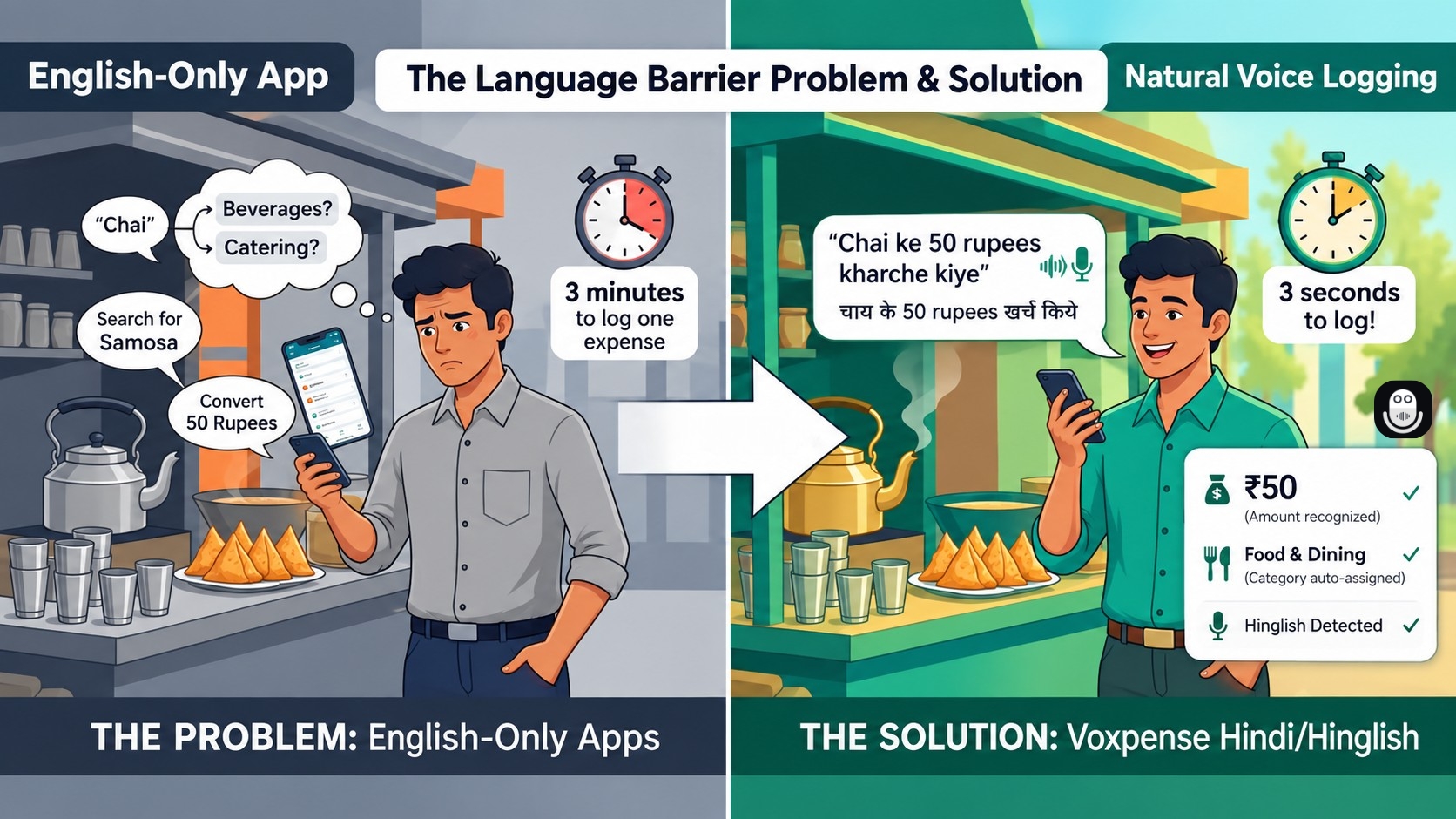
Now open a typical budgeting app and try to log that same expense. Most require you to type “Breakfast — ₹500 — Food,” navigate multiple menus, and select a category. It works, technically. But that’s not how you naturally think about money, and this daily friction makes many budgeting apps easy to abandon.
Why English-Only Budget Apps Don’t Work for India
India isn’t a one-language market, and it was never going to be. A Hindi expense tracker using only textbook Hindi misses how people naturally mix languages. A shopkeeper’s bill, a family WhatsApp group, or a quick voice note naturally blends Hindi, English, and regional languages.
Most finance apps translate the interface for global users but don’t adapt to how people actually talk about money. The result is a tool that asks you to think in formal English before you can track a ₹50 chai. That’s an extra mental step most people skip, and skipping it means the expense never gets logged at all.
Voxpense takes a different approach. Instead of asking you to reformat your spending into proper English sentences, it listens the way a person would. Say “500 Rs chai aur nashte pe kharch kiya” out loud, and the AI does three things almost instantly:
Picks out the amount — ₹500
Understands the context — chai and nashta (breakfast)
Auto-categorizes it under Food & Dining
No dropdowns, no manual entry, no translating your thoughts before you can use the app. This is what makes Voxpense a genuine voice budget app that Indian users can stick with, because it removes the one habit-killing step that most trackers never solve: the gap between how you think and how the app expects you to type.
From Hindi to Hinglish to 20 More Languages
Voxpense supports voice input in English, Hindi, and 19 more languages, including Marathi, Tamil, Telugu, Kannada, Gujarati, and Punjabi. That alone makes it one of the more complete options if you specifically want to track expenses in Hindi without fighting an English-first interface.
But the more useful part, for most Indian users, is the Hinglish handling. You don’t have to pick a language and stay locked into it. You can say “kal Swiggy pe order kiya tha, 340 rupees” in one breath, switch to full English for the next entry, and mix in a regional word here and there — the AI keeps up with all of it. That’s what genuinely qualifies Voxpense as a Hinglish finance app, not just an app with a language selector bolted on.
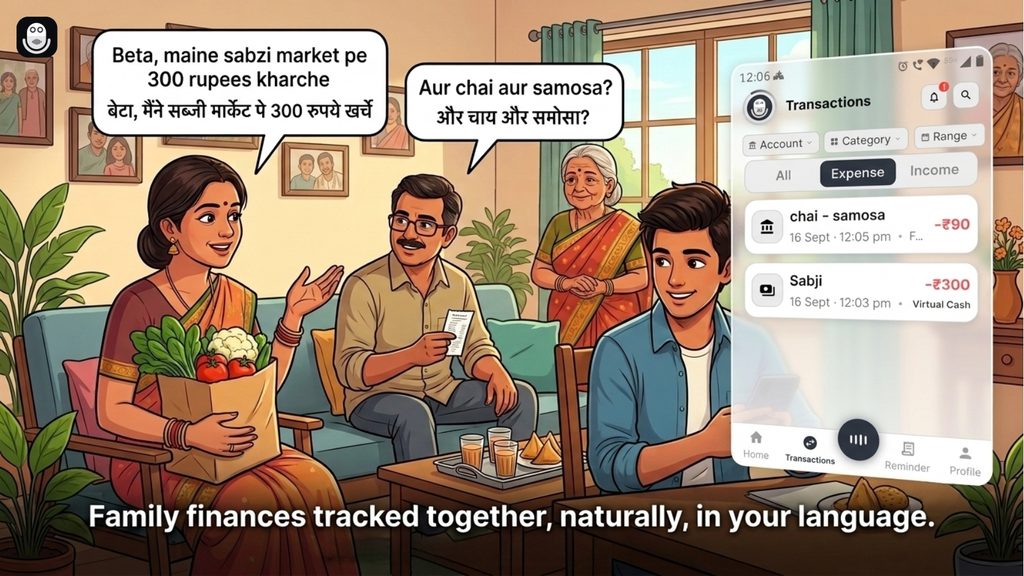
For families and households where different members are more comfortable in different languages — a parent who prefers Hindi, a sibling who defaults to English, a grandparent who speaks Tamil — a single regional language budget app that adapts to each speaker, rather than forcing everyone into one language, ends up being the version that the whole household actually uses.
Why This Matters for Budgeting Accuracy
Every finance app can only report on the data it captures. A budgeting tool becomes accurate not because its charts are pretty, but because logging an expense takes five seconds and zero mental translation. When the friction of “how do I even phrase this” disappears, people log more consistently — the coffee, the auto fare, the quick grocery run — instead of only remembering the big-ticket spends at the end of the month.
That consistency is what turns a budgeting app from a once-a-month guilt exercise into an actual daily habit. And once daily voice logging in your own language becomes routine, the reports, category breakdowns, and budget alerts built on top of that data start meaning something, because they’re built on real, complete spending — not a partial picture typed in whatever language felt easiest to type quickly.
Getting Started
Voxpense is free to download, with no bank account connection required and no card details needed to start. Voice logging in English and Hindi is available on the free plan, with all 21 languages —including Hinglish handling across the board —unlocked on Pro, currently free for early users.
If budgeting apps have never quite stuck for you, it may not be a discipline problem. It might simply be that no app so far has understood the way you actually talk about your money. Speak your next expense the way you’d say it to a friend, and see what Voxpense makes of it.
If you’ve ever hesitated before entering your bank login credentials into a budgeting app, you’re not alone.
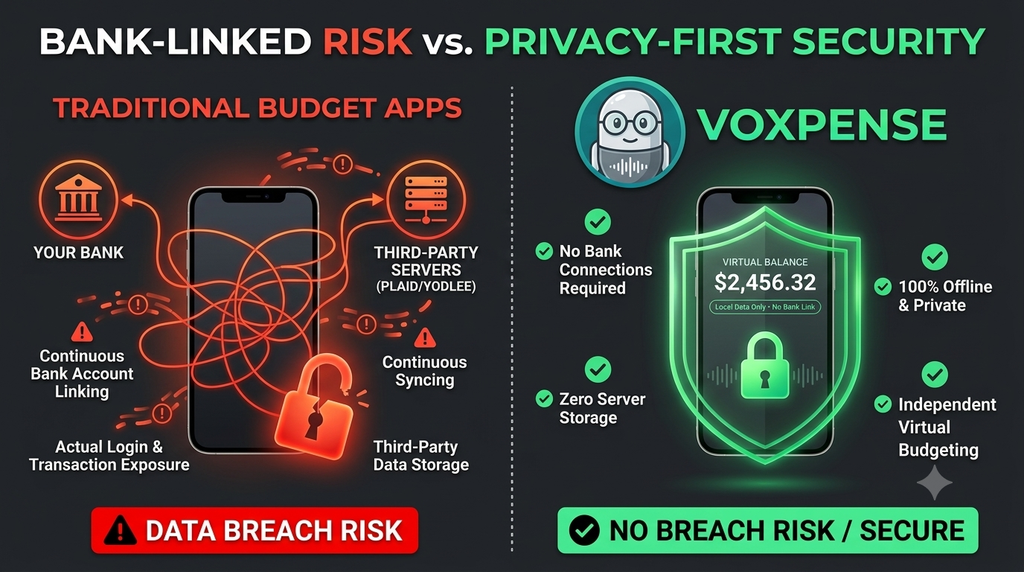
Every time you grant a budget app access to your bank account through services like Plaid or Yodlee, you’re essentially handing over your financial keys to a third party. One data breach. One security vulnerability. One compromised server. And suddenly, your account numbers, transaction history, and personal financial information are exposed to identity thieves.
Most users report concerns about sharing banking credentials with third-party apps. Yet most “modern” budget apps make bank linking non-negotiable—they’ve built their entire infrastructure around automated data syncing.
What if you didn’t have to choose between privacy and powerful budgeting insights?
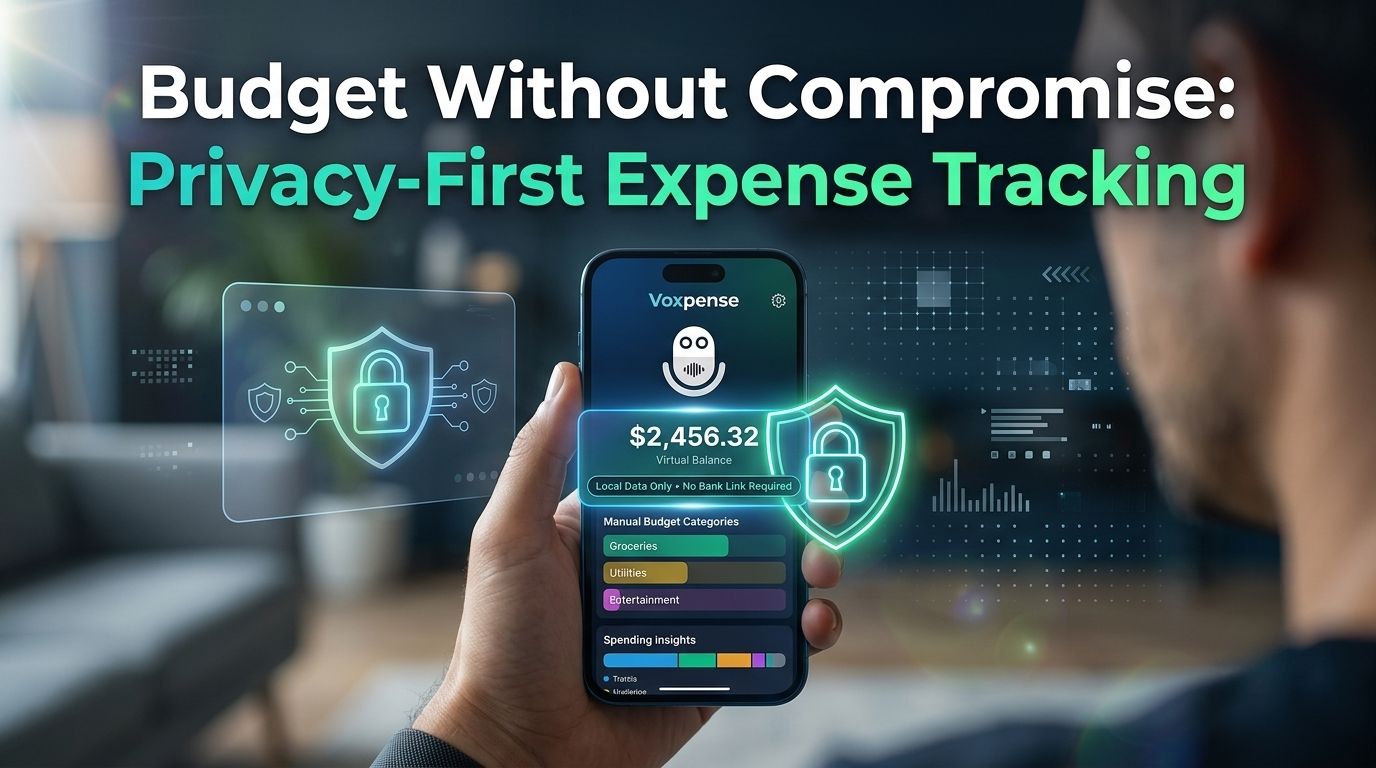
Welcome to the privacy-first approach: an expense tracker without bank sync – Voxpense that delivers automation, AI insights, and detailed financial tracking—all without compromising your data security.
The Dark Side of Automatic Bank Syncing
Modern budgeting apps promise convenience: “Link your bank account once, and we’ll handle everything automatically.” It sounds ideal. But the convenience comes at a high cost.
When you use a budget app with no bank account linking, you’re avoiding a cascade of privacy risks:
1. Data Breach Exposure
Apps that aggregate financial data become high-value targets for hackers. In 2023, major financial aggregation services experienced breaches affecting millions of users. Your transaction data, account numbers, and personal identifiers were compromised—not because your bank was hacked, but because a third-party service that stored your financial information was.
2. Third-Party Data Sharing
Even reputable apps share anonymized (but often re-identifiable) data with marketing companies, data brokers, and advertisers. Your spending patterns become valuable commodities. Financial apps may sell insights about which merchants you frequent, how much you spend on dining or entertainment, and your overall financial behavior.
3. Unnecessary Data Accumulation
Automatic bank syncing stores unnecessary information: your full transaction history, merchant details, account balances, and personal financial metadata. Most budgeting features don’t actually need this level of detail. You’re handing over raw data when summary data would suffice.
4. Credential Vulnerability
When you share your bank login credentials (even through “secure” aggregation services), those credentials are stored on external servers. If that service gets breached, attackers gain direct access to your banking portal.
This is why privacy-conscious users are increasingly demanding expense trackers without bank sync alternatives. And they’re discovering that manual or semi-automated approaches actually offer better control, transparency, and security.
The Privacy-First Solution: Virtual Balance Tracking
The best approach to expense tracking isn’t the most automated—it’s the most transparent and secure.
A secure virtual balance budget system works differently:
Instead of syncing to your actual bank account, you manually create a “virtual balance” representing your spending budget or account total. As you log expenses, this virtual balance decreases—giving you real-time visibility into your remaining funds without your app ever accessing your actual banking credentials.
This approach delivers three critical advantages:
1. Complete Privacy
Your bank login credentials never leave your possession. Your app never stores your actual account numbers, PIN codes, or transaction data. There’s nothing to breach because there’s nothing to access. Your financial data stays with your bank, where security infrastructure is built specifically to protect it.
2. Full Transparency
You see exactly what data the app has and doesn’t have. There’s no hidden syncing, no background data collection, no aggregation of your information. What you log is what you get—nothing more.
3. Superior Control
When you manually log expenses, you decide what gets tracked and what doesn’t. Want to hide certain purchases from your spouse? With complete control, you decide what stays private. Similarly, tracking specific spending categories is entirely up to you. Most importantly, there are no algorithmic surprises or confusing data interpretations.
How Voxpense’s Virtual Balance Works
Voxpense takes the private finance app concept and enhances it with AI-powered insights that don’t require bank access.
Here’s how it works:
Step 1: Set Your Virtual Balance: First, create a virtual balance that represents your monthly budget, paycheck amount, or account total. This gives you complete control, as you decide the amount to enter and only you know the actual figure.
Step 2: Log Expenses (Manually or Via Receipt Import). As you spend, you log expenses into the app. Voxpense makes this fast and frictionless—capture receipts via phone camera, use voice input, or enter transactions manually. No waiting for bank syncs. No mysterious auto-categorizations.
Step 3: Receive AI-Powered Insights. This is where the privacy-first approach gets sophisticated. Voxpense analyzes your logged spending patterns—not raw banking data—to deliver:
Spending trends showing which categories drain your budget
Predictive budgeting forecasting future spending based on your patterns
Smart recommendations suggesting areas for savings
Category-based insights showing exactly where your money goes
All of this happens without your app ever touching your actual bank account. Moreover, because there’s no paid integration, you face fewer security risks and avoid unnecessary third-party data accumulation.
Why This Matters: Real Privacy in the Age of Data Breaches
Consider this scenario: A user who chose a traditional budget app with bank syncing experiences a data breach. Her account numbers are compromised. She faces potential identity theft. She spends weeks disputing fraudulent transactions and placing fraud alerts with credit bureaus.
A Voxpense user with the same bank? The breach doesn’t affect them. Because their app never stored account credentials in the first place, there’s nothing to breach.
The privacy difference isn’t theoretical—it’s existential.
The Transparency Advantage
Beyond security, the expense tracker without bank sync approach offers unexpected benefits:
More Accurate Data
Your logged expenses are exactly what you choose to track. As a result, there are no algorithmic misclassifications or automatic categorizations that split your morning coffee between “food” and “beverages.” Instead, what you log is exactly what you get.
Better Behavioral Insights
By intentionally logging your expenses, you become more aware of your spending habits. As a result, this increased mindfulness can help reduce impulse spending. In fact, some studies suggest that tracking expenses may lead to a 10–15% reduction in impulse spending.
Family Financial Transparency
For households managing finances together, manual logging creates clear and discussable records. As a result, both partners can see exactly what’s being tracked, with no hidden algorithms or third-party data interpretation.
Why Banks Aren’t the Right Custodians of App Data
Here’s the crucial insight: Your bank’s job is to protect your money. It’s not your bank’s job—or interest—to protect third-party app access to your accounts.
When you grant Plaid or Yodlee access to your bank account, you’re creating an additional security layer that doesn’t add value. The convenience isn’t worth the risk.
With Voxpense’s virtual balance approach, you get:
AI-powered financial insights (no bank access needed)
Real-time budget tracking (fully transparent)
Seamless expense logging (fast and intuitive)
Complete privacy (credentials stay yours)
Zero data breach risk (nothing to expose)
The User Segment Demanding Privacy-First Tools
The demand for privacy-first financial tools is growing. This isn’t a niche preference—it’s a fundamental shift in how users view financial data:
36% of users have abandoned budgeting apps due to privacy concerns
52% of users distrust automatic bank syncing
68% of users prefer manual control over their financial data
78% of users want visible, transparent data handling
Voxpense serves this massive, underserved segment: users who want powerful budgeting without privacy compromise.
Getting Started with Privacy-First Budgeting
If you’ve been avoiding budget apps due to bank-linking concerns, it’s time to reconsider. Voxpense proves that you don’t need to sacrifice privacy for powerful financial tools.
Here’s how to start:
Create your account (no credentials required)
Set your virtual balance (any amount you choose)
Start logging expenses (via receipt, voice, or manual entry)
Let AI insights emerge (no syncing, no waiting)
Own your financial data (completely and always)
Ultimately, the best expense tracker isn’t the one with the most integrations. Instead, it’s the one that trusts you to stay in control of your own data.
Ready to budget without compromise? Download Voxpense today and experience expense tracking that respects your privacy from day one.
No bank login or third-party access required, helping protect your data from unnecessary exposure and breaches.